The people who wrote the rulebook.
The great ad-men didn't have analytics dashboards. They had typewriters, coupons and a fierce habit of testing. Their lessons still work, because people haven't changed.
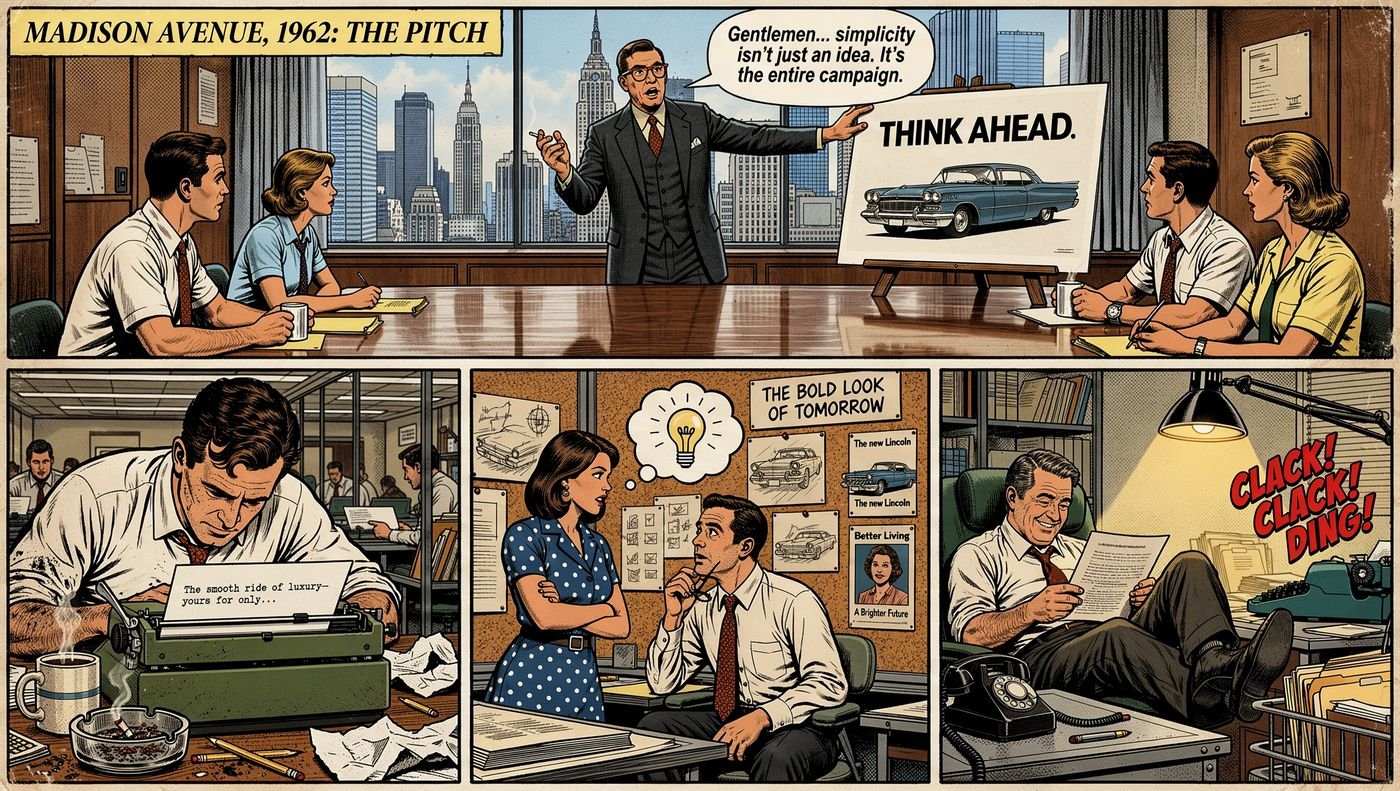
Ogilvy and Kennedy, in ten moves.
Each one ends with something to try on your own copy today.
Know your reader inside out
"The consumer isn't a moron; she is your wife," wrote David Ogilvy in 1963. Respect the reader, then study them: what keeps them up at night, what they secretly want. Dan Kennedy calls it matching the message to the market.
TRY IT · Write down three things your reader worries about that they'd never say out loud.
Your headline is most of the ad
"On average, five times as many people read the headline as read the body copy." Ogilvy's Rolls-Royce headline worked because it was specific: "At 60 miles an hour the loudest noise in this new Rolls-Royce comes from the electric clock."
TRY IT · Write 20 headlines for one piece before you choose one.
Sell the hole, not the drill
The old line "people don't want a quarter-inch drill, they want a quarter-inch hole" comes from Harvard's Theodore Levitt, and Dan Kennedy built a career on it. Translate every feature into what it means for the reader's life.
TRY IT · List every feature, then ask "Why does this matter?" until you hit a feeling.
Specifics build credibility
"Lose weight" is forgettable. A precise, true detail sticks, like the clock in that Rolls-Royce. Exact numbers and outcomes read as proof.
TRY IT · Replace your three vaguest claims with numbers you can back up.
Urgency without gimmicks
Fake scarcity gets found out. Real urgency comes from real deadlines and real consequences, stated honestly.
TRY IT · Name one true reason to act now, and say why the limit exists.
Tell a story that sells
Ogilvy's man in the Hathaway shirt wore an eye patch, and readers wanted to know why. A story makes facts feel personal.
TRY IT · Write a three-sentence story: the struggle, the turn, the result.
Answer objections head-on
Every unanswered doubt is a reason not to buy. List them all (price, time, trust) and answer each one in the copy.
TRY IT · Write the five objections your buyer has, then one honest answer to each.
Write the way you talk
Ogilvy told his staff to write the way they talk, naturally, with short words and short sentences. Simple isn't dumb. It's effective.
TRY IT · Read your page aloud. Rewrite every sentence you stumble on.
Tell them exactly what to do
"Learn more" is a shrug. A strong call to action says what to do, what happens next and what they get.
TRY IT · Rewrite your main button so it names the benefit.
Test everything
Ogilvy tested headlines. Kennedy tested offers. Nothing is sacred until the numbers say it sells.
TRY IT · Run two versions of one headline this week and keep the winner.
The same rules, for a five-second swipe.
Big ideas still win. But clarity wins faster.
Lead with clarity
Clever headlines are cute. Clear ones convert.
Every line earns the next
The headline sells the first line. The first line sells the second. Even bullets need to pull.
The pitch is a conversation
Mirror their problems and speak their language. Precision, not pressure.
Proof isn't optional
If you say it, it's marketing. If they say it, it's proof.
Think past the sale
Keep delivering after the purchase. A returning customer is the cheapest one you'll ever win.
More from the legends.
Gary Halbert's Sales Letter, Taken Apart
Line by line through one of direct mail's most famous letters, and what to steal from it.
In productionDan Kennedy's "Selling Opportunity"
Why people buy opportunities rather than products, and how to write for that.
In productionCopywriting Tips from the Masters
Short, sharp rules from the classic copywriters, with a modern example for each.
In production